Activity Highlights
The Future of Semiconductor Talent: Next Door to TSMC, Taiwan's NYCU Cultivates Entrepreneurs
Originally published in the August 3, 2026 edition of Weekly Dempa Shimbun.
Written by Taro Kamematsu, special correspondent for Weekly Dempa Shimbun

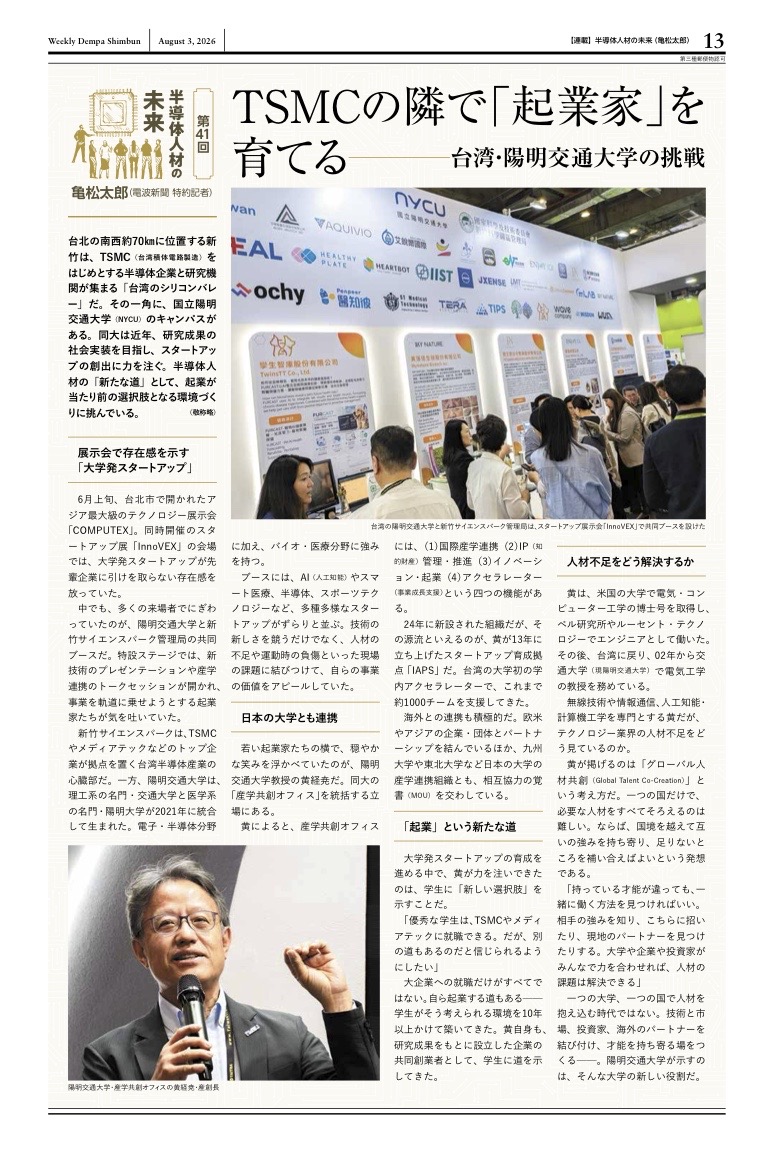
Photo caption: National Yang Ming Chiao Tung University and the Hsinchu Science Park Bureau co-hosted a booth at InnoVEX, a startup exhibition in Taiwan.
Hsinchu, about 70 kilometers southwest of Taipei, is known as "Taiwan's Silicon Valley" — home to TSMC and a dense cluster of other chip companies and research institutes. The campus of National Yang Ming Chiao Tung University (NYCU) sits in the middle of it. In recent years, the university has pushed to bring research into commercial applications, putting significant effort into fostering startups. Its aim is to build an environment where founding a company is a normal career choice — a "new path" for semiconductor talent.
University startups make their mark at the show
In early June, Taipei hosted COMPUTEX, one of Asia's largest technology exhibitions. At InnoVEX, the startup showcase held alongside it, university startups held their own against more established companies.
One of the busiest spots on the floor was the joint booth run by NYCU and the Hsinchu Science Park Bureau. On its dedicated stage, founders working to get their businesses off the ground presented new technologies and took part in talk sessions on industry-academia collaboration. Hsinchu Science Park is the heart of Taiwan's semiconductor industry, where leading firms such as TSMC and MediaTek are based. NYCU, for its part, was created in 2021 through the merger of two prestigious institutions: National Chiao Tung University, strong in science and engineering, and National Yang Ming University, strong in medicine. That gives it strengths in biotech and healthcare on top of electronics and semiconductors. The booth featured a wide range of startups working in AI, digital health, semiconductors, sports technology and other fields. Rather than simply competing on how novel their technology was, they pitched the value of their businesses by tying them to real-world problems such as labor shortages and sports injuries.
One of the busiest spots on the floor was the joint booth run by NYCU and the Hsinchu Science Park Bureau. On its dedicated stage, founders working to get their businesses off the ground presented new technologies and took part in talk sessions on industry-academia collaboration. Hsinchu Science Park is the heart of Taiwan's semiconductor industry, where leading firms such as TSMC and MediaTek are based. NYCU, for its part, was created in 2021 through the merger of two prestigious institutions: National Chiao Tung University, strong in science and engineering, and National Yang Ming University, strong in medicine. That gives it strengths in biotech and healthcare on top of electronics and semiconductors. The booth featured a wide range of startups working in AI, digital health, semiconductors, sports technology and other fields. Rather than simply competing on how novel their technology was, they pitched the value of their businesses by tying them to real-world problems such as labor shortages and sports injuries.
Partnerships with Japanese universities
Standing beside the young founders with a gentle smile was NYCU professor Ching-Yao Huang. He serves as Vice President of the university's Office of Industry-Academia Co-Creation. According to Huang, the office has four functions: (1) international industry-academia collaboration, (2) intellectual property management and promotion, (3) innovation and entrepreneurship, and (4) accelerator programs supporting business growth. The office itself was established in 2024, but its origins trace back to IAPS (the Center of Industry Accelerator and Patent Strategy), a startup accelerator Huang launched in 2013. It was the first in-house accelerator at a Taiwanese university, and it has supported roughly 1,000 teams to date. The university is also active internationally. Beyond partnerships with companies and organizations in Europe, the United States and Asia, it has signed memorandums of understanding on mutual cooperation with the industry-academia collaboration arms of Japanese universities, including Kyushu University and Tohoku University.
Entrepreneurship as a new path
As he has worked to build up university startups, Huang has focused on opening up a new career path for students. "Our best students can get jobs at TSMC or MediaTek. But I want them to believe another path is possible." A job at a major corporation is not the only option. Students can also start their own companies — and Huang has spent more than a decade building an environment where they can see that. He has also led by example, as co-founder of a company built on his own research.
How to solve the talent shortage
Huang earned his doctorate in electrical and computer engineering at a U.S. university and worked as an engineer at Bell Labs and Lucent Technologies. He then returned to Taiwan, and since 2002 has been a professor of electrical engineering at Chiao Tung University, now NYCU. Huang specializes in wireless technology, information and communications, and AI and computer engineering. So how does he view the technology industry's talent shortage? His answer is a concept he calls "Global Talent Co-Creation." No single country can supply all the talent it needs. The idea, then, is to pool strengths across borders and cover one another's gaps. "Even if people have different talents, we can find a way to work together. We need to understand each other’s strengths, invite talented people here, or find local partners. If universities, companies and investors all combine their efforts, we can solve the talent problem." The era of a single university, or a single country, keeping talent to itself is over. Connecting technology with markets, investors and overseas partners, and creating ecosystems where talent can come together — that is the new role NYCU envisions for universities.

Photo caption: Ching-Yao Huang, Vice President of the Office of Industry-Academia Co-Creation, National Yang Ming Chiao Tung University